
Fire Damage Restoration Portland, OR
After a house fire, the hardest part often isn't the fire itself, it's everything that comes after: figuring out what's actually salvageable, what needs to be rebuilt, and how to get insurance and construction moving in the same direction. Lamont Bros. Design & Construction provides fire damage restoration in Portland for homeowners who need that entire process managed by one team, from the first walkthrough to the final finish work.
Rebuilding Portland Homes After Fire & Smoke Damage
Portland's neighborhoods bring real variation to a fire renovation project. A craftsman in Sellwood with original plaster walls and built-in cabinetry needs a different restoration approach than a newer build in outer Southeast, and a home tucked into the West Hills often comes with steeper access and extra structural review during permitting. We've built our process to account for that variation rather than treat every rebuild the same way.
Our fire and smoke damage restoration work covers homeowners throughout:
Alameda, Irvington, and the inner Northeast neighborhoods.
Sellwood, Eastmoreland, and inner Southeast.
Multnomah Village, Hillsdale, and Southwest Portland.
The West Hills and other hillside properties.
Portland neighborhoods citywide.
Portland Fire Damage Restoration & Reconstruction
Most fire recovery starts with a mitigation company handling emergency drying, board-up, and stabilization. That work protects the home from further damage, but it doesn't rebuild it. Once mitigation wraps up, someone still has to reframe walls, replace insulation, restore mechanical systems, and put the home back together in a way that looks and functions like it did before the fire, ideally better in some cases. That's the phase we handle. Our scope on a typical Portland rebuild includes:
-
Demolition and removal of fire- and smoke-compromised materials.
-
Structural framing repair or full replacement where heat exposure has weakened it.
-
HVAC evaluation and restoration after smoke contamination.
-
Electrical and plumbing repairs tied to fire or suppression damage.
-
Rebuilding to current Portland code, including any upgrades the repair triggers.
-
Matching finish details: trim profiles, custom cabinetry, and flooring transitions that blend with what remains of the original home.
Some fires stay contained to one surface or one room, and the repair is straightforward. Others turn out to be bigger than they first appear once contractors get behind the drywall. Signs that a Portland fire rebuild has moved into large-loss territory include damage spanning multiple rooms or floors, smoke that's worked its way into attic space or wall cavities, framing exposed to enough heat to lose structural integrity, or water damage left behind by fire suppression efforts. Reconstruction costs climbing past six figures is another common marker. When a project hits this scale, sequencing matters. Structural work, systems repair, insulation, drywall, and finish carpentry all have to happen in the right order, or you end up paying for the same fix twice.
Working with Insurance on a Fire Claim
Insurance adjusters typically write an initial estimate early, often before anyone has opened a wall or pulled insulation. Once demolition starts and the real extent of the damage becomes visible, that original estimate usually needs updating. We treat this as a normal part of the process rather than a delay, and our documentation is built to support it:
Room-by-room assessment of structural and system damage as it's uncovered.
Photo documentation adjusters can reference directly.
Material specs that match pre-loss quality rather than defaulting to the cheapest equivalent.
Cost breakdowns organized to make scope changes easy to review and approve.
We're not public adjusters, but we work directly with your insurance representative throughout construction so the approved scope and the actual rebuild stay in sync.
How Long Does a Fire Rebuild Take?
There's no single timeline that applies to every project, since so much depends on how much of the structure was affected and how quickly the city processes permits. Based on typical project scope:
-
Minor structural involvement: 3 to 6 months.
-
Moderate multi-room reconstruction: 6 to 9 months.
-
Extensive structural rebuilds: 9 to 12+ months.
Homes in Portland's hillside areas or older housing stock often add time upfront due to engineering review, but that early planning is usually what keeps the actual construction phase on schedule.
Why a Design-Build Contractor Makes a Difference
A fire rebuild touches nearly every trade in a house, which is exactly where things go wrong when design and construction aren't connected. Materials picked after demolition has already started tend to create problems: a trim profile that doesn't quite match, a flooring transition that's visibly off, cabinetry that doesn't sit right next to the original woodwork. Lamont Bros. runs design and construction as a single process, which means materials get selected and scope gets defined before the crew starts tearing anything out. Homeowners deal with one team managing design, budgeting, insurance documentation, and construction together, instead of piecing that coordination together themselves across separate designers, contractors, and adjusters.
Our Insurance Restoration Work
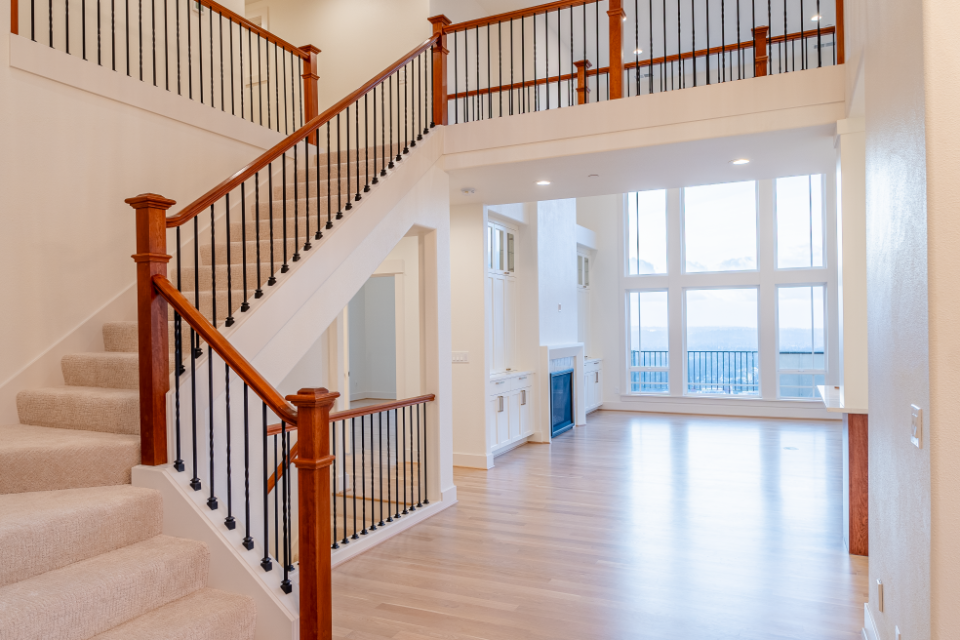
Fire & Smoke Damage | Lamont Bros. Design & Construction
Frequently Asked Questions
Have Question? We are here to help
What is the difference between fire mitigation and fire restoration?
Fire mitigation focuses on emergency response: securing the property, removing debris, and preventing further damage.
Fire restoration begins after mitigation and involves structural repairs, rebuilding, replacing damaged systems, and restoring the home to pre-loss condition.
Mitigation companies handle immediate stabilization, smoke removal, water extraction (from firefighting), and board-up services.
A fire damage restoration contractor like Lamont Bros. Design & Construction manages full reconstruction, including framing, roofing, insulation, electrical, plumbing, drywall, cabinetry, and finish work.
Many large-loss fire projects require both phases.
How much does fire damage restoration cost?
Costs vary widely based on severity, but structural fire restoration projects typically range from tens of thousands to several hundred thousand dollars.
Cost drivers include:
- Extent of structural damage
- Smoke and soot infiltration
- HVAC replacement
- Finish level and material quality
- Code upgrades required during rebuild
- Insurance coverage limits
Because most projects are insurance-funded, the contractor’s role is to develop an accurate scope of work aligned with your policy coverage.
Do I need a licensed contractor for fire reconstruction in Oregon?
Yes. Structural fire reconstruction requires a properly licensed Oregon contractor and may require engineering review and municipal permits depending on scope.
Learn more: Insurance Preferred Providers vs Independent Contractors
Will my home insurance cover fire damage restoration?
Most homeowner insurance policies cover fire damage restoration, including structural repairs and rebuilding, subject to your coverage limits and deductible.
Your contractor does not act as a public adjuster but can:
- Provide detailed scope documentation
- Submit cost breakdowns
- Respond to adjuster questions
- Clarify construction requirements
- Working with a contractor experienced in insurance reconstruction, like Lamont Bros. Design & Construction, reduces scope disputes and delays.
Learn more: Does Homeowner's Insurance Cover Renovations After Damage?
How soon should reconstruction begin after mitigation?
Reconstruction planning should begin immediately after stabilization to prevent delays in insurance approvals and material selection.
Can you restore a home with severe smoke and structural damage?
Yes. Most homes with structural fire damage can be restored unless damage exceeds rebuilding thresholds or local codes require demolition.
A structural assessment determines:
- Load-bearing integrity
- Roof framing stability
- Subfloor and joist damage
- Hidden smoke infiltration
In many cases, partial demolition and reconstruction allow the majority of the home to be restored safely and compliantly.
Will rebuilding after a fire require code upgrades?
In many cases, yes. Structural repair can trigger updates to meet current building codes, particularly in electrical, insulation, or seismic standards.
Do I need permits for fire damage restoration?
Yes. Structural repairs, electrical replacement, plumbing, HVAC, and major reconstruction typically require permits and inspections.
A licensed restoration contractor like Lamont Bros. Design & Construction manages:
- Permit applications
- Engineering documentation
- Inspection scheduling
- Code compliance upgrades
- Permit oversight protects resale value and ensures safety compliance.
Can you match custom cabinetry and architectural details?
Yes. Replicating trim profiles, built-ins, hardwood flooring, and specialty finishes is a core component of high-quality fire restoration for custom homes.
Should I choose a restoration company or a design-build contractor for my fire damaged house?
Mitigation companies handle cleanup; design-build contractors handle complete reconstruction. For large structural fire losses, a design-build restoration contractor provides better long-term results.
Traditional restoration companies focus on drying and debris removal. A design-build contractor such as Lamont Bros. Design & Construction will do the following:
- Coordinates architecture and engineering
- Rebuilds structural systems
- Restores custom finishes
- Improves functionality where appropriate
This approach is especially valuable for high-end homes or complex rebuilds.
What happens if the insurance estimate is lower than the reconstruction cost?
Insurance estimates are almost always lower than they should be, often by as much as ten times lower than the work will prove to cost.
However, with detailed documentation and scope clarification, Lamont Bros. Design & Construction can provide assistance in increasing the final insurance payment to a more realistic and appropriate number.
Learn more: 6 Things to Understand About Your Homeowner's Insurance Policy
What happens if my home needs to be partially demolished?
Targeted demolition removes damaged structural and finish materials while preserving salvageable areas.
Selective demolition allows:
- Inspection of hidden framing damage
- Smoke removal from wall cavities
- Safe replacement of compromised materials
The goal is to restore structural integrity while minimizing unnecessary removal.
How do I choose the right fire damage restoration contractor in Portland?
Look for a licensed contractor experienced in structural reconstruction, insurance coordination, and high-quality finish work — not just emergency cleanup services.
Learn more: What Type of Contractor is Best for Insurance Repair?
How do you document fire damage for home insurance approval?
We create detailed scope-of-work documentation with measurements, photos, cost breakdowns, and construction sequencing.
Documentation includes:
- Pre-loss condition assumptions
- Line-item cost breakdowns
- Material specifications
- Code upgrade requirements
- Timeline projections
Clear documentation reduces change orders and claim disputes.
When should I hire a fire damage restoration contractor?
You should hire a fire damage restoration contractor once mitigation is complete and structural repairs are needed to rebuild the home.
If the fire caused framing damage, roof compromise, smoke infiltration into structural cavities, or destroyed interior finishes, a licensed contractor is required. In Portland and surrounding areas, most structural repairs also require permits and inspections—something a design-build restoration contractor like Lamont Bros. Design & Construction coordinates on your behalf.
What areas do you serve for fire damage restoration?
We provide fire damage restoration contractor services throughout the Portland metro area, serving Portland, Beaverton, Lake Oswego, West Linn, Oregon City, and surrounding Oregon communities.
Local knowledge of permitting offices, inspectors, and regional building codes allows us to streamline approvals and construction timelines.
How long does fire damage restoration take?
Most fire restoration projects take anywhere from 3 to 9 months depending on structural damage, permitting, and insurance approval timelines.
Timeline factors include:
- Structural framing or roof rebuild
- Electrical and mechanical system replacement
- Permit approval
- Insurance scope revisions
- Custom cabinetry or specialty finishes
Large-loss projects involving major reconstruction may take longer. Clear documentation and early contractor involvement help reduce delays.
